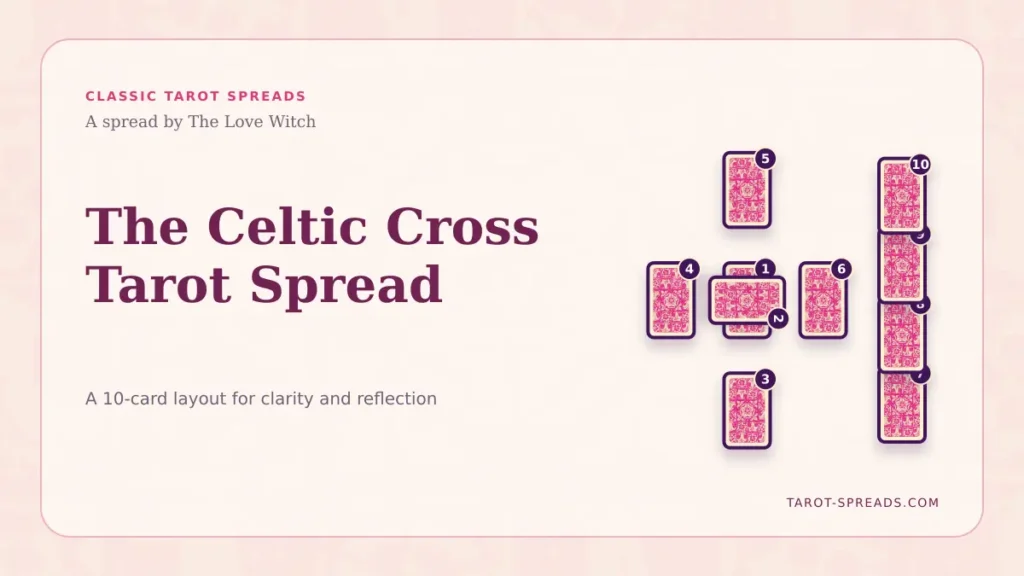
The Celtic Cross is one of tarot’s best-known spreads because it can hold a complex situation without reducing it to a single prediction. Its ten positions explore the heart of the matter, what shaped it, what is emerging, how you are meeting it, and where the present trajectory may lead.
Use the Celtic Cross for a layered question with enough importance and complexity to justify ten cards. For a simple daily decision, a smaller spread will usually be clearer.
The Ten Celtic Cross Positions
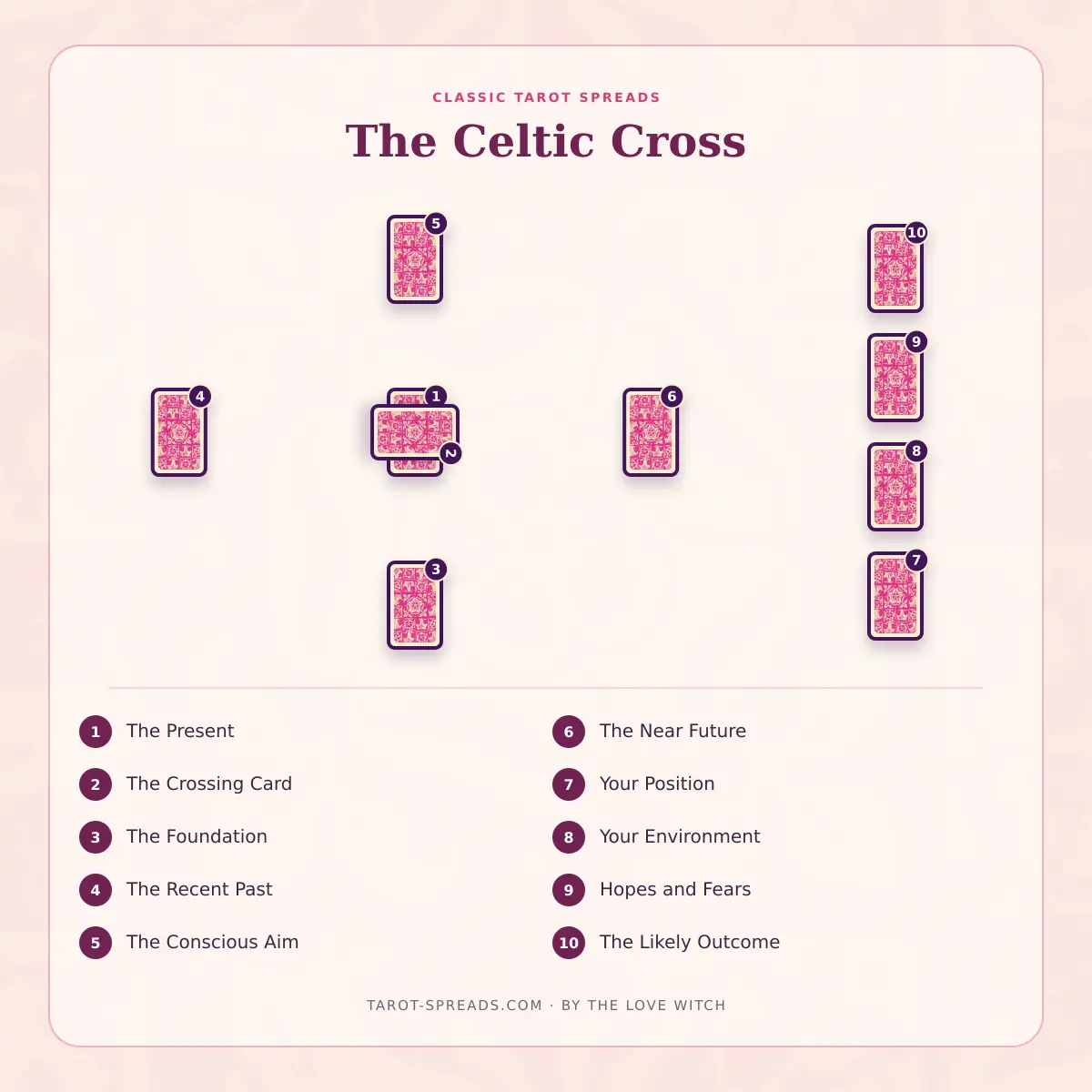
- The Present — the central energy of the situation.
- The Crossing Card — the challenge, tension, or force interacting with it.
- The Foundation — the deeper root or condition beneath the question.
- The Recent Past — what is passing away or has shaped the present.
- The Conscious Aim — what you want, expect, or are trying to understand.
- The Near Future — the next development on the current path.
- Your Position — your attitude, power, fear, or way of participating.
- Your Environment — outside influences, other people, or surrounding conditions.
- Hopes and Fears — the emotional stake that can clarify or distort the reading.
- The Likely Outcome — where the current pattern tends if nothing significant changes.
Before You Shuffle
Choose one clear question. “What do I need to understand about my relationship over the next three months?” will produce a more useful reading than “Tell me everything.” Decide on a reasonable timeframe and your approach to reversals before drawing.
How to Lay Out the Cards
Place card one in the center and card two horizontally across it. Place card three below, card four to the left, card five above, and card six to the right, forming the cross. Build a vertical staff of four cards to the right: seven at the bottom, then eight, nine, and ten at the top.
Read the Cross First
Cards one and two define the immediate problem. Cards three through six provide its movement through time and consciousness: foundation, past, aim, and next development. Before interpreting individual details, summarize these six cards as one paragraph.
Then Read the Staff
The staff shows how you and the wider situation interact. Compare card seven with card eight: does your approach match the environment, or are you responding to conditions that no longer exist? Card nine reveals the emotional charge around card ten and often explains why the outcome feels desirable, frightening, or both.
How to Understand the Outcome Card
Card ten is not an unavoidable fate. It describes the likely destination of the energies already present. If you welcome it, cards five through eight can show how to support it. If you do not, identify which behavior, influence, or assumption must change to create a different trajectory.
Patterns to Look For
- A dominant suit showing the area where most energy is concentrated.
- Repeated numbers or court cards pointing to a developmental theme or important people.
- Major Arcana cards marking parts of the situation with broader life significance.
- Contrasts between cards three and five, or seven and eight.
- Visual direction: where figures look, move, approach, or turn away.
Questions the Celtic Cross Works Well For
- What do I need to understand about this relationship?
- How is this career situation likely to develop?
- What forces are shaping this major transition?
- How am I participating in the pattern I am experiencing?
- What could help me change the current trajectory?
A Grounding Reminder
A ten-card reading does not have to produce ten separate predictions. The Celtic Cross becomes useful when the cards speak to one another. Look for the central story, then use the details to deepen it.
Keep this reading close
Email Me This Spread
Get this exact spread in your inbox, plus a discount code for a private reading.