
Intuition can be quiet, embodied, and informed by patterns you have not yet put into words. It can also be confused with anxiety, wishful thinking, or a familiar protective response. This six-card spread treats intuition as one source of information to be tested alongside evidence, values, and practical judgment.
Trusting intuition does not mean refusing evidence. Mature intuition becomes more reliable when it is allowed to be questioned and refined.
The Spread at a Glance
- The Intuitive Signal — Notice the simple impression, body response, recurring pattern, or quiet knowing beneath explanation.
- The Fear Signal — Identify urgency, catastrophic prediction, hypervigilance, avoidance, or an old alarm that may be shaping interpretation.
- What the Evidence Shows — Consider observable behavior, facts, history, expert information, and what remains genuinely unknown.
- The Bias I Should Notice — This may be a desired outcome, past wound, assumption, social pressure, or selective attention.
- The Value That Can Guide Me — Return to the principle you want your decision to embody, such as safety, honesty, care, freedom, fairness, or growth.
- A Grounded Way to Test It — Choose a low-risk question, conversation, pause, boundary, experiment, or information-gathering step.
Before You Shuffle
Name the decision or impression without asking the cards to prove it. Ask: “What is my intuition noticing, and how can I evaluate it wisely?” If the issue concerns health, safety, money, or law, include qualified advice and verifiable information.
How to Lay Out the Cards
Create two rows of three cards. The top row shows the intuitive signal, the fear signal, and available evidence. The bottom row reveals bias, the value guiding you, and a grounded way to test the message.
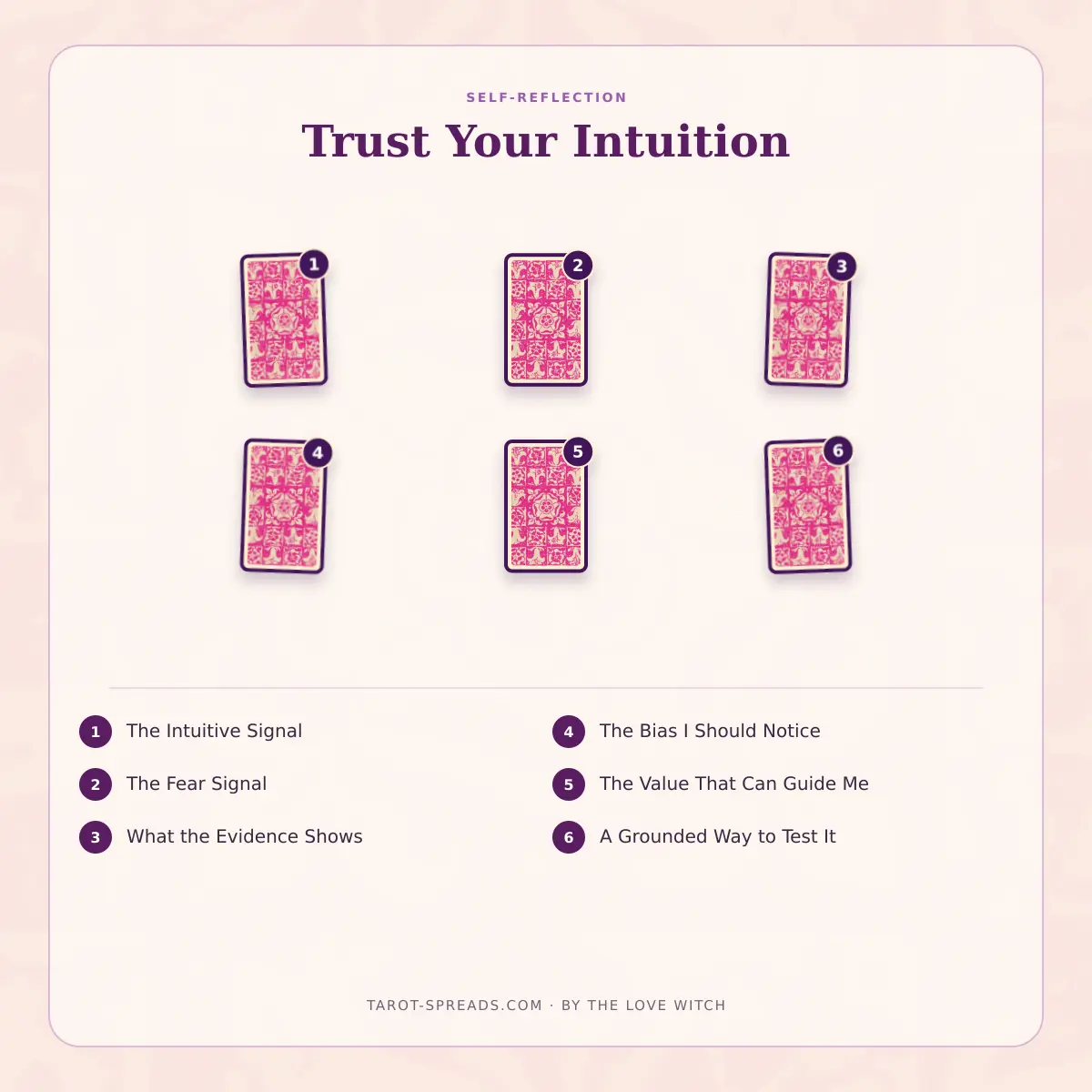
Card 1: The Intuitive Signal
Notice the simple impression, body response, recurring pattern, or quiet knowing beneath explanation.
Card 2: The Fear Signal
Identify urgency, catastrophic prediction, hypervigilance, avoidance, or an old alarm that may be shaping interpretation.
Card 3: What the Evidence Shows
Consider observable behavior, facts, history, expert information, and what remains genuinely unknown.
Card 4: The Bias I Should Notice
This may be a desired outcome, past wound, assumption, social pressure, or selective attention.
Card 5: The Value That Can Guide Me
Return to the principle you want your decision to embody, such as safety, honesty, care, freedom, fairness, or growth.
Card 6: A Grounded Way to Test It
Choose a low-risk question, conversation, pause, boundary, experiment, or information-gathering step.
How to Read the Story
Do not force cards one and two into opposites; both may contain information. Card three anchors the reading, and card four keeps certainty from outrunning self-awareness. Cards five and six show how to act without requiring perfect proof.
Questions This Spread Can Help With
- What is the quiet signal beneath the noise?
- How does fear sound different in me?
- Which facts support or challenge my impression?
- What outcome am I attached to?
- How can I test this safely?
A Grounding Reminder
Intuition is strengthened by reflection, feedback, and reality testing. A reading should help you become more discerning, not more certain than the evidence allows.
Related Tarot Spreads
Keep this reading close
Email Me This Spread
Get this exact spread in your inbox, plus a discount code for a private reading.